

THE QUARTERLY COMPASS Q2 2026 | Aspira Wealth, Victoria, BC
Market context, portfolio positioning, and investment outlook from your wealth advisory team
Alex Vozian, CFA | Co-Founder and Portfolio Manager

Rome was not built in a day - Photo by Alex from a recent family trip - Rome, Italy.
Q2 2026 markets reminded investors that patience matters
Despite Middle East tensions, renewed inflation concerns, and questions about the economy, Canadian and U.S. equity markets recovered quickly from their March decline and reached new highs during Q2 2026. That does not mean every part of the market moved together. After a strong start to the year, some Aspira portfolios gave back part of earlier large gains as market leadership temporarily shifted.
Our current stance is simple: stay invested and be selective.
In late Q1 2026, investor fear was high. By the end of Q2 and early July 2026, fear had subsided and investor optimism had strengthened. That change matters. When fear is high, opportunities often improve. When optimism is high, we prefer to be more patient with new purchases.
This does not mean trying to time the market but rather being careful about the price we pay for new investments.
Q2 Market Review: Resilient, but Not Risk-Free
The second quarter brought several important developments.
The Middle East conflict disrupted energy markets and raised concern about the Strait of Hormuz, an important route for global commodities, including oil. AI-related spending also continued to accelerate, supporting demand for data centres, semiconductors, networking equipment, copper, power, and other infrastructure inputs. Inflationary pressures re-emerged due to the Middle East conflict and continued AI-related spending. Central banks became more cautious.
Yet markets remained resilient. Canadian and U.S. equities hit new highs during the quarter, and even emerging markets held up better than many investors expected.
The lesson is not that headlines do not matter. They do. The lesson is that markets often look past scary headlines faster than investors expect. This is why reacting emotionally to short-term news can be costly.
Canadian (XIC - red line) and U.S. (SPY – blue line) stock markets since the start of 2026.
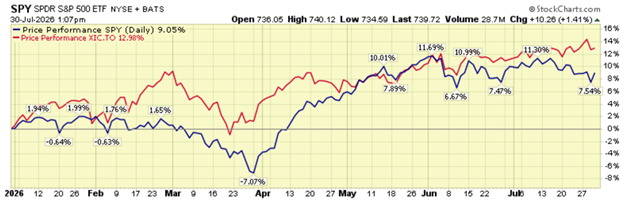
Chart courtesy of StockCharts.com
Five Years of Resilience and Growth
The past five years have included the effects of the 2020 pandemic, trade disputes, military conflicts, a banking crisis, and concerns about private credit. Through all of that, disciplined equity investors were rewarded with strong cumulative returns.
That history is useful, but it should not make us complacent. Strong past returns can pull future returns forward. Valuations are higher than they were earlier in the cycle, so we believe investors should expect more moderate gains ahead, even if long-term opportunities remain attractive.
We should not expect every five-year period to look like the last one. Good planning should leave room for both growth and setbacks.
Canadian (XIC - red line) and U.S. (SPY – blue line) stock markets – 5-year chart
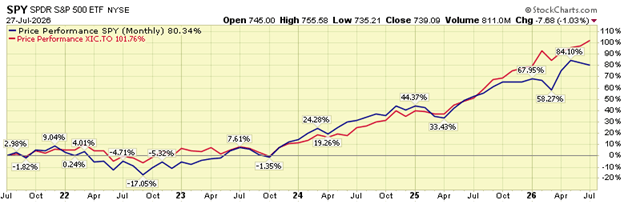
Chart courtesy of StockCharts.com
One Surprise: The Oil Shock Was Less Severe Than Feared
The disruption around the Strait of Hormuz created fears of a major energy shock. Some analysts, ourselves included, worried that a large portion of global oil supply could be at risk, with the potential to push inflation high enough to potentially cause a global recession.
Oil prices did rise, but not to the $150-$200 per barrel range that some analysts predicted. Instead, oil generally traded in a range closer to $90-$110 per barrel before falling to approximately $67 in early July 2026 and then revisiting the $90 level last week.
Several factors appear to have helped. The world had some excess supply, strategic inventories were used, production increased in non-Gulf regions, and markets seemed to believe the disruption would not become a permanent loss of supply. China also appears to have reduced imports significantly, which may have eased pressure on global oil demand. Nevertheless, global oil demand continues to grow. For example, global airline traffic reached a new record high this week. When one considers how many people around the world have never flown but aspire to do so, the long-term demand picture remains compelling.
The global economy had more shock absorbers than expected. That is encouraging. However, if the conflict deepens or lasts longer than expected, oil prices could still move materially higher, and we have certainly seen evidence of that throughout July.
Positive Signals from Leading Indicators
We continue to monitor several leading indicators that suggest the economy is still growing, at least for now.
- Copper prices reached record highs in early June and stayed strong through Q2, supported by demand from data centres, electrification, and energy infrastructure. All Aspira equity strategies currently participate in this theme through selective exposure to copper miners.
- Semiconductor stocks also reflected strong economic growth driven by high demand for advanced computing and data infrastructure. However, we continue to prefer more selective or indirect ways to participate in AI infrastructure rather than owning direct semiconductor exposure.
- Business investment also remains a positive signal. U.S. core capital goods orders, a widely followed measure of business investment, grew rapidly in June 2026, posting one of the strongest growth rates of the past decade.
Portfolio Management
Our positioning reflects two beliefs that can both be true at the same time. First, we remain long-term believers in equities. Second, we are not in a rush to make large new purchases at current market levels following the recent recovery.
Current positioning:
- Equity strategies remain near fully invested, reflecting our confidence in equities as long-term wealth-building assets.
- We continue to focus on dividend-paying stocks for income and stability.
- We maintain diversified exposure to quality companies in Canada and the United States.
- We maintain a small and selective exposure outside North America.
- We maintain exposure to gold, silver, copper, energy, and uranium.
- We may maintain or selectively increase technology exposure, where risk and valuation make sense.
- We expect the U.S. dollar to remain range-bound compared to the Canadian dollar, much as it has over the past decade.
For new and existing accounts with available cash, we expect to be less aggressive in deploying that cash over the coming months. This is not a defensive retreat. Rather, it reflects a more patient approach to deploying capital.
Three main risks we are watching:
- Inflation and interest rates: If energy prices rise to new highs, inflation could re-accelerate. That could make central banks even more cautious and keep interest rates higher for longer.
- AI expectations: AI infrastructure spending remains a powerful theme, but expectations are high. Investors are increasingly asking whether the capital being spent will generate attractive returns.
- Investor complacency: Fear was high in late Q1, but by Q2 investor sentiment had become much more balanced, and at times more optimistic. Low levels of fear can be positive in the short run, but they can also leave markets more vulnerable to disappointment.
Our plan is to stay diversified, avoid overconfidence, and remain ready to act if volatility creates better opportunities.
Closing Thought
Rome was not built in a day, and neither is long-term family wealth.
Markets will continue to test investors with wars, inflation scares, interest-rate changes, political uncertainty, and new technologies, and other unforeseen developments. Our job is not to react to every headline. Our job is to keep your portfolio aligned with your long-term goals, adjust when the facts change, and remain disciplined when emotions run high.
Thank you for your continued trust.
If this newsletter raises questions about your portfolio, cash deployment, retirement income, or the market outlook, please reach out to our team. We are happy to talk through what it means for you and your family.
Alex Vozian, CFA
Co-Founder and Portfolio Manager
Aspira Wealth
July 30, 2026.
P.S. Asking a Big Favor
In less than a month, my daughter Angelina and I will be riding the second-longest route of Ryder Hesjedal's Tour de Victoria: 140 km! We are doing this to raise funds for BC Cancer.
Any donation would be greatly appreciated. Thank you in advance for your generosity to this great cause.

The information contained in this report was obtained from sources believed to be reliable, however, we cannot represent that it is accurate or complete and it should not be considered personal tax advice. This report is provided as a general source of information and should not be considered personal investment advice or solicitation to buy or sell securities. The views expressed are those of the author and not necessarily those of Raymond James. We are not tax advisors and we recommend that clients seek independent advice from a professional advisor on tax-related matters. This provides links to other Internet sites for the convenience of users. Raymond James Ltd./Raymond James (USA) Ltd is not responsible for the availability or content of these external sites, nor does Raymond James Ltd/Raymond James (USA) Ltd endorse, warrant or guarantee the products, services or information described or offered at these other Internet sites. Users cannot assume that the external sites will abide by the same Privacy Policy which Raymond James Ltd/Raymond James (USA) Ltd adheres to. Raymond James Ltd., Member—Canadian Investor Protection Fund. Raymond James (USA) Ltd. (RJLU) advisors may only conduct business with residents of the states and/or jurisdictions for which they are properly registered. Raymond James (USA) Ltd. is a member of FINRA/SIPC.