

THE QUARTERLY COMPASS Q3 2026 | Aspira Wealth, Victoria, BC
Market context, portfolio positioning, and investment outlook from your wealth advisory team
Alex Vozian, CFA | Co-Founder and Portfolio Manager

A poppy in full sun against deep shade, Finnerty Gardens, Victoria. Photo by Alex Vozian.
The Quarter in Three Sentences
- Corporate profits grew strongly in Q3 and carried stock markets higher, even as interest rates and oil prices rose sharply.
- The U.S. central bank raised rates for the first time in three years, and long-term borrowing costs reached their highest levels in over 20 years.
- Our stance: stay invested and selective: this quarter we refined our energy holdings, trimmed interest-rate-sensitive companies, raised some cash to use when volatility offers better prices, and locked in higher bond yields in one of our strategies.
What Moved Markets
1. Interest rates moved higher, fast
The U.S. 10-year government bond yield recently reached 5.3% - its highest level in over 20 years. Three forces drove it: large government deficits, record corporate borrowing to fund AI data centres, and inflation that remains above target. In September, the U.S. Federal Reserve raised its policy rate to 3.75%-4.00%, and markets see another increase as possible in December.
This matters in Canada too. Canadian bond yields tend to follow U.S. yields, and all of Canada's largest banks have recently raised some fixed mortgage rates. The Bank of Canada has held its rate at 2.25% for a year, but September inflation of 3.1%, driven mostly by gasoline prices, has put a rate increase on the table for its October 28 decision.
Higher rates are a headwind for borrowers and stock prices, but a tailwind for income investors: high-quality bonds now pay above inflation, an opportunity we used this quarter.
2. The oil shock came back
Last quarter we noted that oil had significantly eased. That relief did not last. Attacks on Middle East shipping and infrastructure pushed Brent oil prices above US$100 in September and above US$110 in October. Diesel, which moves almost everything we buy, reached record prices in the U.S. The International Energy Agency has warned that energy markets may not normalize during 2027. Energy has been the best-performing U.S. stock sector this year, up about 53% year-to-date.
Canada is better placed than most: as an energy exporter, it gains from higher oil prices through export revenue, investment and government royalties, even as Canadians feel the pain at the pump. Energy also makes up about 16% of the TSX, compared with under 4% of the S&P 500.
Our energy exposure has helped offset the inflation pain that higher fuel prices create elsewhere. This is exactly why we hold it.
3. Profits strong, prices cautious
U.S. company earnings expectations for the next 12 months have risen about 30% this year, yet the S&P 500 is up only about 14%. Investors are paying less for each dollar of profit because higher interest rates make bonds a stronger competitor. AI spending remains enormous, with the five largest technology companies expected to spend close to $1 trillion this year. The cracks are appearing at the edges: a few heavily indebted AI infrastructure companies now pay junk-bond interest rates near 15%, and their shares have fallen sharply.
Canada's market looks very different: banks and other financial companies, mining and energy make up about 70% of the TSX, while technology is under 10%, compared with close to 40% of the S&P 500. Canadian investors are less exposed to the AI boom, for better and for worse.
Stocks got cheaper relative to their profits this year even as prices rose. That is a healthier setup than prices racing ahead of earnings.
The Five-Year View: Rewarded for Staying Invested
Over the past five years, Canadian stocks returned about 15% per year and U.S. stocks about 13% per year.
Chart: Canadian (XIC - red line) and U.S. (SPY – blue line) stock markets – 5-year chart
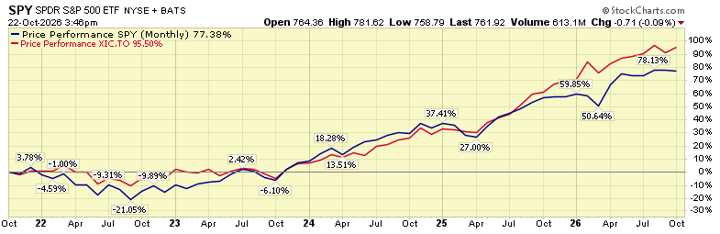
Chart courtesy of StockCharts.com
Those gains came despite plenty of reasons to worry: the highest inflation in 40 years, the fastest interest-rate increases in decades, a bear market in 2022, U.S. bank failures in 2023, wars in Ukraine and the Middle East and oil shocks, new tariffs, a record wave of Canadian mortgage renewals at higher rates, and repeated warnings of recession and an AI bubble. Investors who sold to wait for calmer times often missed much of the recovery.
We do not expect the next five years to repeat the last five. Starting interest rates are higher, many stock prices already reflect strong profit growth, and bonds and savings now offer real competition. We expect lower equity returns over the medium term, which we still consider attractive for long-term investors.
Staying invested through the worries paid off. Expect good, not spectacular, returns from here, and build your plan on realistic numbers.
How We're Positioned and What Changed
What changed since our last update:
- Metals and energy holdings, refined: we replaced or trimmed some of our metals and energy holdings.
- Cash, used and then rebuilt: in the summer we put some idle cash and short-term bond holdings to work. In September and October, we raised cash in some strategies to have money ready
- Fixed income, locking in higher rates: in one of our fixed income strategies we sold a floating-rate bond fund and bought an investment-grade Canadian corporate bond maturing in 2032, locking in a higher rate for almost six years.
- Additional adjustments: we trimmed our exposure to interest-sensitive holdings, among other adjustments across our strategies.
What stayed the same:
- Our equity holdings remain focused on quality, dividend-paying companies in Canada and the U.S. with some modest exposure to global developed and emerging markets.
- For diversification and inflation protection, we continue to hold companies from gold, copper, energy, and uranium sectors.
- We remain selective with technology and prefer indirect ways to participate in the AI buildout.
- New client money continues to be invested gradually rather than all at once.
- We expect the U.S.-Canadian dollar exchange rate to stay within its 10-year range, so currency should not drive long-term returns.
What We're Watching
Risks, and the signal we are tracking:
- Interest rates: if the U.S. 10-year yield goes above about 5.5%, pressure on stock prices and borrowers would increase.
- Oil: we are watching whether oil breaks above its spring 2026 highs, which could slow global growth and push inflation higher.
- AI financing stress: so far, the problems are limited to weaker, highly indebted AI infrastructure firms. We are watching spending cuts by the largest, financially strong technology companies, which would be a more serious signal.
- Trade: the U.S. declined to renew CUSMA, the Canada-U.S.-Mexico trade agreement, in July. It remains in force but now faces annual reviews, and new tariffs have followed. We are watching the effect on Canadian company earnings.
Opportunities:
- Income while we wait: high-interest savings pay a modest return while we wait for better prices, and quality bonds and GICs now let investors lock in roughly 3.5% to 4.5% for several years, as we did this quarter.
- Quality might be on sale soon: we think a temporary 10-20% market decline is more likely today than a few months ago. The cash we raised means we are ready to act if it happens.
Closing Thought: Do We Get What We Focus On?
On a visit to Finnerty Gardens this summer, I spotted a yellow poppy lit by direct sun while everything behind it sat in deep shade. I chose to focus on the beautiful flower, and the shade simply fell away in the photo.
Investing works much the same way. Over the past five years, people who focused on saving and investing for the long term were well rewarded, while those who focused on every market fear often stayed out of the market. The shade never disappears. What matters is where we put our attention.
This quarter tested investors with higher rates, another oil shock, and the first real cracks in the AI financing boom. Through it, most businesses we own kept growing their profits. Our job is not to ignore the shade, but to see it clearly, adjust when the facts change, and keep our attention on what grows your wealth over time.
Thank you for your continued trust. It truly means a lot to our team.
Alex Vozian, CFA
Co-Founder and Portfolio Manager
Aspira Wealth
October 22, 2026.
The information contained in this report was obtained from sources believed to be reliable, however, we cannot represent that it is accurate or complete and it should not be considered personal tax advice. This report is provided as a general source of information and should not be considered personal investment advice or solicitation to buy or sell securities. The views expressed are those of the author and not necessarily those of Raymond James. We are not tax advisors and we recommend that clients seek independent advice from a professional advisor on tax-related matters. This provides links to other Internet sites for the convenience of users. Raymond James Ltd./Raymond James (USA) Ltd is not responsible for the availability or content of these external sites, nor does Raymond James Ltd/Raymond James (USA) Ltd endorse, warrant or guarantee the products, services or information described or offered at these other Internet sites. Users cannot assume that the external sites will abide by the same Privacy Policy which Raymond James Ltd/Raymond James (USA) Ltd adheres to. Raymond James Ltd., Member—Canadian Investor Protection Fund. Raymond James (USA) Ltd. (RJLU) advisors may only conduct business with residents of the states and/or jurisdictions for which they are properly registered. Raymond James (USA) Ltd. is a member of FINRA/SIPC.